

For lube and fuel oil filter vessels, changeover valves and coalescers
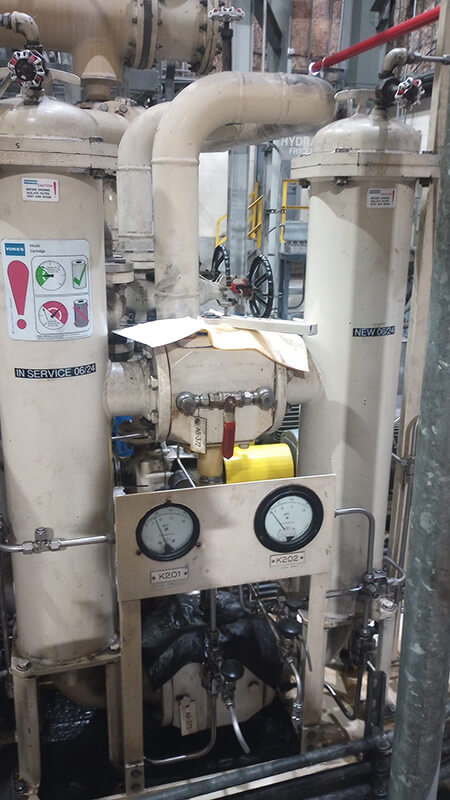 Most maintenance schedules change the element and leave the seal in place. That is why filter vessels leak.
A filter vessel is a simple thing. There are only two parts on it that wear: the cartridge and the seal that keeps the oil where it belongs. The cartridge gets changed on a schedule. The seal gets changed when somebody notices oil running down the outside of the vessel, usually onto a hot surface, usually at the worst moment.
We hold and supply replacement seals, gaskets, O-rings and complete seal kits for lube and fuel oil filter vessels, duplex changeover valves (transflow valves), drop sump bowl gaskets and coalescer housings - including equipment that has been out of production for thirty, forty or fifty years.
Send us a photo - we'll identify it
You probably don't know who made your filter, and that's normal
Filter vessels were very rarely branded by the company that built them. Vokes built filters that went out on Mirrlees, Ruston, Paxman, English Electric, Allen and Alsthom equipment, badged by the engine or turbine builder. Vokes built and sold filter vessels and coalescers under its own name, but the company changed hands many times, Thomas Tilling, BTR, McLeod Russell, SPX and the Guildford works closed in 2004. So it's understandable if you don't know, or can't find, who made your vessel. The same story runs through Ruston: Ruston & Hornsby, Ruston Gas Turbines, European Gas Turbines, ALSTOM, Siemens.
So the nameplate on your vessel may carry a company that no longer exists, under a part-numbering system that was abandoned three owners ago. You are not doing anything wrong by not knowing what you have. Almost nobody does.
That identification problem is the whole of our business. Send us whatever you've got, and we'll work back to the right seal.
How to identify the seal, seal kit, O-rings or gaskets you need
You need any one of the following or just send us what you have, and we'll work it out.
The number stamped on the vessel
Look on the nameplate, or casting or stamped into the head casting. Numbers like FTD3, TS338, E426L, HD4, 360/9, DD31. If you can read the vessel model, we can usually go straight to the seal.
See our vessel model to seal kit lookup table
An old part number from the manual or a previous order
Vessel numbers, OEM cross-references, superseded numbers, numbers handwritten in the back of a maintenance log, all of it is useful. Numbers like 64/05002021/7, CT3009/12, BX00712PC, UK430-025-003 mean something to us.
Measurements from the old seal
Three dimensions identify almost any static seal. Take them from the old seal, and take them before it goes in the bin:
- Inside diameter (ID): across the hole, inside edge to inside edge
- Outside diameter (OD): across the whole ring, outside edge to outside edge
- Section (cord) thickness: the thickness of the rubber itself
Measure in millimetres. If the seal is a rectangular-section joint ring rather than a round-section O-ring, tell us that too; it matters, and the two are not interchangeable.
A used seal has been compressed, sometimes for years. Expect the measurements to be a little under nominal. Give us what you actually measure, and we'll work it back to the standard size, don't round it for us.
A photograph
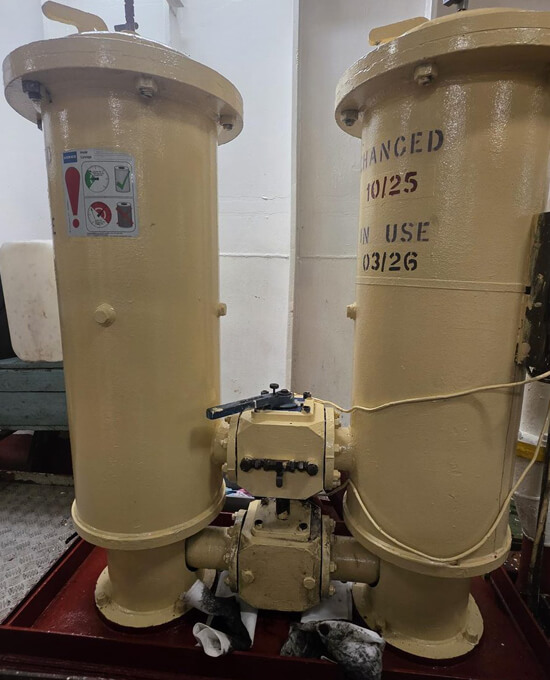
If you have no numbers and no callipers, photograph the old seal next to a steel rule or a tape, and photograph the vessel it came out of, including the nameplate. That is usually enough.
What we supply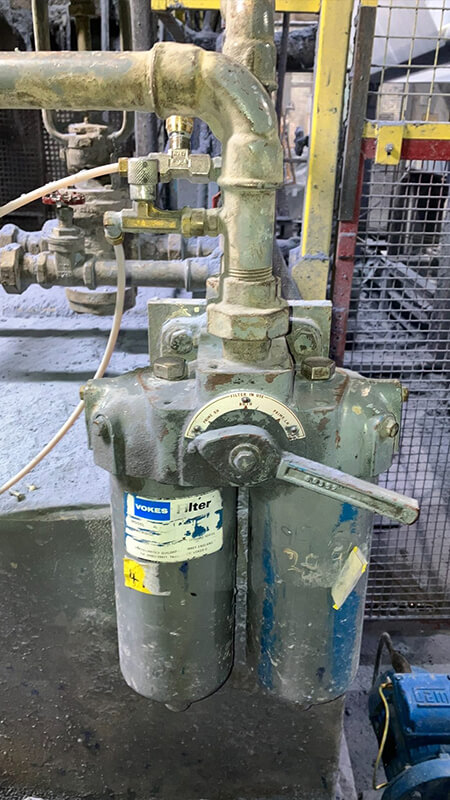
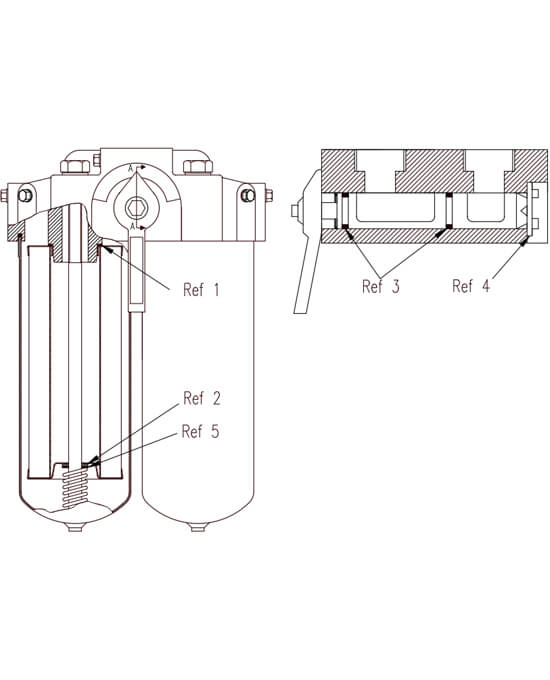
- Vessel cover and lid seals: the main joint between the head casting and the body of a top-servicing vessel. The one that leaks.
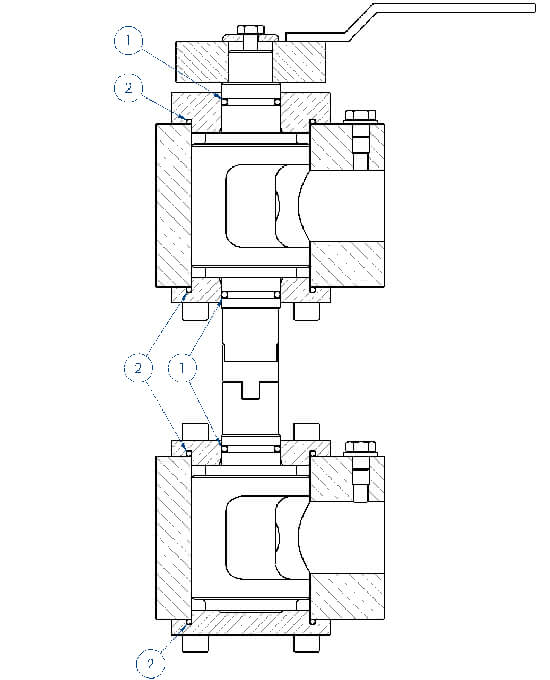
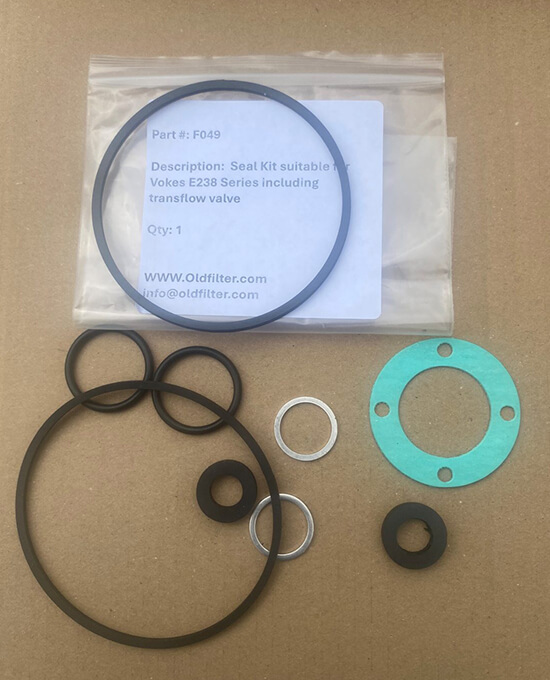
- Changeover valve seal kits: for duplex filters with transflow or changeover valves, where a worn valve seal lets unfiltered oil bypass into the clean side. This is the failure nobody sees, because it doesn't drip. More on changeover valve seal kits. Generally consisting of Gaskets, and O rings
- Drop sump bowl seals: for compact engine-mounted units where the bowl drops away below the head casting.
- Coalescer housing seals: covering models 360-1, 361-1, 361-2, 360-6, 360-9, 360-12
- Element sealing rings and end cap seals: where the cartridge seals into the housing rather than against it.
Material and temperature: get this right
The single most common failure we see is the correct size in the wrong compound. It seals beautifully on day one, hardens, cracks and lets go a few months later.
Nitrile (NBR)
The default for mineral lube oil and distillate fuel at moderate temperature. Good oil resistance, good compression set, inexpensive. Practical continuous ceiling around 100–120 °C, depending on the compound and the duty.
Fluoroelastomer (FKM / Viton)
For higher temperature, heavy fuel oil, steam-jacketed and trace-heated vessels, and anywhere the duty is aggressive. Considerably more expensive, considerably longer-lived in the right application.
Where this bites on real equipment
Some vessels in this class are rated well above nitrile's comfortable working range. Units with a design temperature at or above 120 °C and particularly heavy fuel oil vessels with steam jackets or trace heating need checking before you order a nitrile seal, because a standard NBR ring in a 160 °C duty is a seal that will fail early and take the next shutdown with it.
Change the seal when you change the element
It is a few pounds of rubber against a shutdown, a clean-up, a slip hazard and a report.
Filter vessels on 20-, 30- and 40-year-old plant have often had the same joint ring in place through a dozen element changes. Every strip-down compresses it further. Every re-fit asks a little more of it. The failure is entirely predictable and entirely avoidable, and it is cheaper to carry a seal kit on the shelf than to explain a lube oil spill.
If you're ordering elements from us, ask for the matching seals in the same order, and we'll put them together.
Equipment we cover
Seals and seal kits for filter vessels and changeover valves on:
- Vokes:Vokes of Guildford, Vokes Filter UK, BTR Vokes DCE Vokes, SPX Vokes
- Mirrlees and Mirrlees Blackstone: K Major, KV Major, MB275, E-series
- Ruston and Ruston Gas Turbines
- Paxman
- English Electric
- Allen Diesels / Rolls-Royce Power Engineering
- Anglo Belgian Corporation (ABC)
- European Gas Turbines / Alstom / Siemens Industrial Turbomachinery (RGT, AGT and EGT units) Vokes Streamline insulating oil plants
If your equipment isn't listed, ask anyway. The list above is what we're asked for most often, not the limit of what we can source.
Frequently asked questions
I only have the number off the filter element, not the vessel. Is that any use?
Yes. The element number usually tells us the vessel family, and the vessel family tells us the seal. It's how a large share of our enquiries start.
Can I just buy an O-ring of the right size locally?
Sometimes, if it's a plain round-section O-ring in a standard size and a suitable compound. Often not many of these vessels use rectangular-section joint rings, moulded profiles or bonded seals that have no off-the-shelf equivalent, and a round O-ring dropped into a groove cut for a square section will not seal reliably.
How long does identification take?
We aim to come back the same working day. A photograph and a vessel number usually helps enormously, but honestly identifying the right O ring or gaskets kit is what take the time.
Do you supply seals on their own, or only with elements?
On their own. Plenty of customers buy seals from us and elements elsewhere, or vice versa. That's fine. We generally supply seal kits with marked up location instructions
Where do you ship?
Worldwide. These engines are in service on every continent and so are our customers power generation, merchant and naval marine, rail traction, pumping and offshore.
Are these genuine OEM parts?
Where an OEM part still exists and makes sense, we can supply it. Where it doesn't which is most of the time on equipment this age we supply a correctly specified equivalent, to the original dimensions and in an appropriate compound. We will always tell you which you are getting.
Tell us what you've got
Send a photo, a part number, a vessel number, or three measurements - any one of them is enough to start. Or just send us what you've got and we'll work it out.
Email:
Real people, not a search box. We answer with an answer, not a form.